
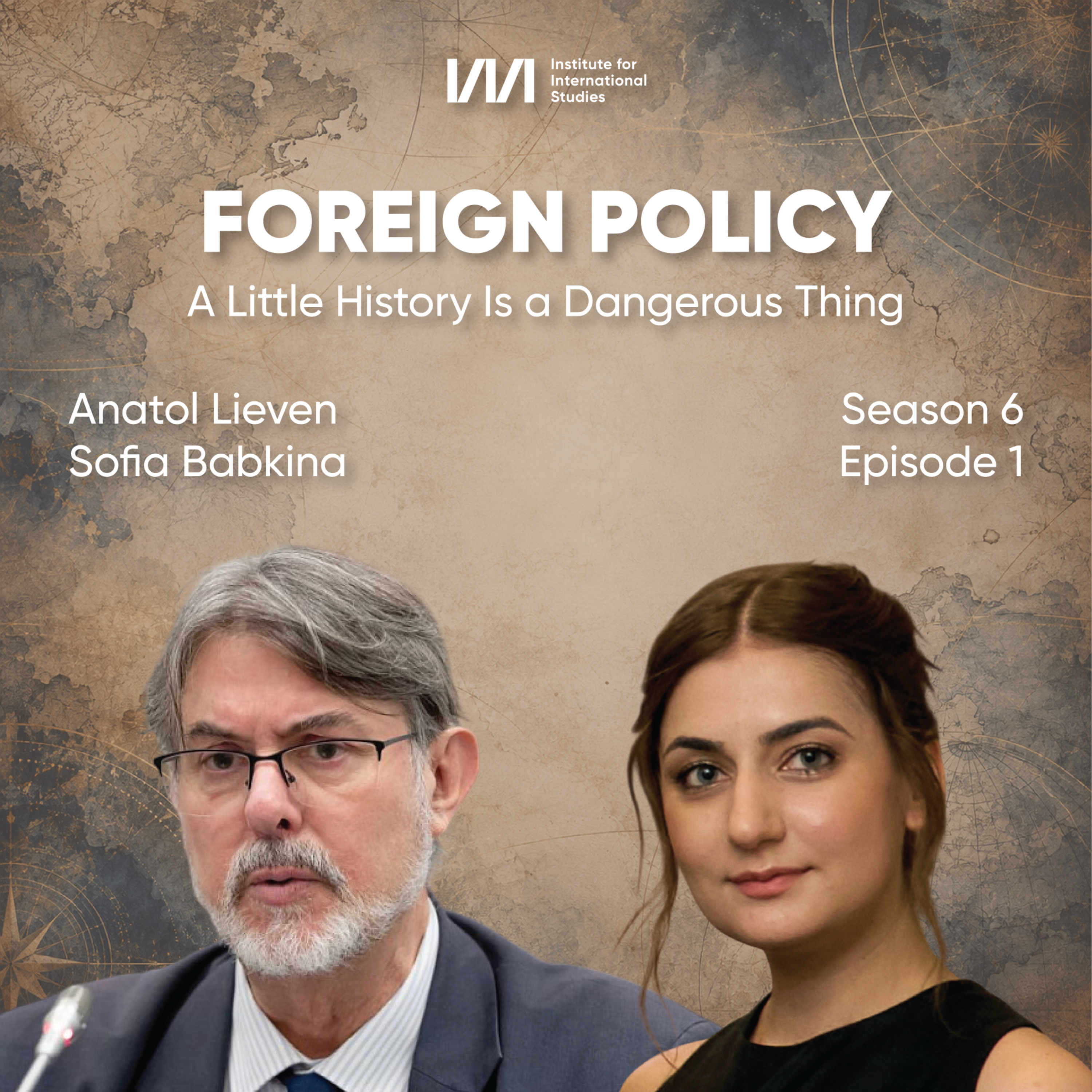
Why do policymakers so often reach for historical analogies — and so often get them wrong? How do nationalism, collective memory and the legacies of empire continue to shape international conflicts? And can foreign policy be guided by realism, prudence and an understanding of the limits of power?
We open the sixth season of Foreign Policy, a podcast by the MGIMO Institute for International Studies, with British historian and political analyst Anatol Lieven. Our conversation explores the uses and misuses of history, post-imperial conflicts, American nationalism and ethical realism, Donald Trump’s foreign policy, the relationship between the United States, Russia, China and Iran, and the emergence of a multipolar — or perhaps multivector — international order.
In our closing quick-fire round, we turn to misleading historical analogies, essential readings, films about war and diplomacy, and the difference between alliances and partnerships.
Guest: Anatol Lieven, Director of the Eurasia Program at the Quincy Institute for Responsible Statecraft
Host: Sofia Babkina, Research Fellow, MGIMO Institute for International Studies
Time Stamps:
Intro: Anatol Lieven on History and Foreign Policy
Why Policymakers Misread History
Historical Narratives and the Russia–Ukraine Conflict
Nationalism, Empire and Post-Imperial Conflicts
From Northern Ireland to Kashmir: The Legacy of Empire
American Nationalism and Ethical Realism
Trump, Iran and the Dangers of Underestimating Nationalism
Multipolarity or Multivector Foreign Policy?
Quick-Fire Round:
The Most Overused Historical Analogy
Essential Reading on History and International Relations
Two Films About War and Diplomacy
Russia and China: Misunderstood Foreign Policies
Alliances vs. Partnerships
One Rule for Using History in Political Analysis
The Institute for International Studies (IIS) is a multi-disciplinary research branch of MGIMO University, established in 1976 as the Problem Research Laboratory for System Analysis of International Relations, and last renamed in 2009. We pride ourselves on our history of conducting innovative, in-depth, applied research in IR.
